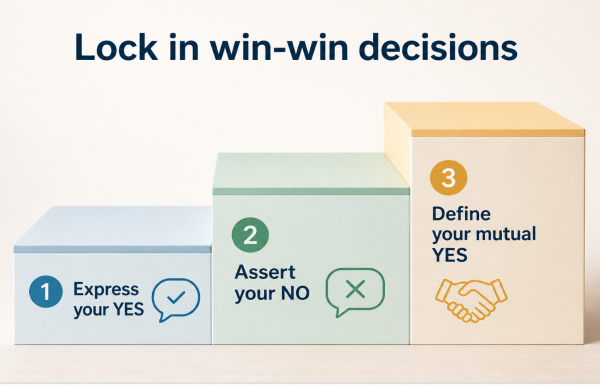
Lock in win-win decisions
How to transform vague agreements into robust mutual decisions that bring clarity, certainty and peace.
I’m Arabella Tresilian, and I work as a mediator. I help people resolve disputes, and I’ve spent the last 10 years exploring how we can communicate better to prevent conflict in the first place. I’ve come to believe that everyone is doing their best to communicate – we just don’t always know how.
This is the fifth and final piece in my series on the five pillars of collaborative dialogue. Briefly, the first four were: own your conflict style, keep the brain in mind, pivot to a future focus, and ask for what you want. Today we’re looking at how to lock in win-win decisions – capturing agreements so clearly that nothing gets lost, blurred or rewritten.
Please note: I have created this article as an AI-assisted synthesis of my webinar transcript, the recording of which you can watch here:
When vague agreements unravel
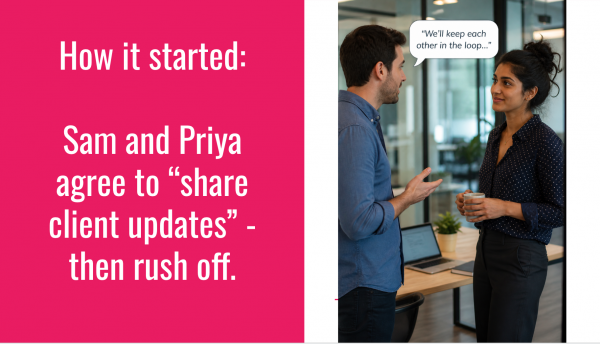
Let me start with a story. Sam and Priya were colleagues working on the same client accounts. After a big meeting they said to each other, “Look, we’ll just keep each other in the loop. We’ll share client updates.” They felt bonded over the collaboration, made their agreement, and rushed off to the next thing.
Unfortunately, that was the start of the decline of their working relationship.
It turned out they had very different ideas about what “sharing updates” actually meant. Nobody really owned what was happening. There were no timelines, so updates came late. One emailed, the other used Slack. One did quick summaries, the other deep dives. Clients got confused when both – or neither – made contact.
Then it escalated up the conflict ladder: blame (“not my fault, yours”), different priorities, no plan B, silently building irritation, mismatched senses of urgency, and a memory clash on what had actually been agreed in the first place.
What they needed was a clear, workable agreement. Who owns client contact? Who handles internal updates, and by when? Which channel for what? What level of detail? Who’s the single client voice? What’s the plan B if someone’s away? When do we review?
It feels easier to say “we’ll keep each other in the loop.” It feels trusting. But trust is actually built through clear understanding – and that comes down to negotiation.
What we mean by negotiation
Negotiation is a strategic discussion that resolves an issue in a way that both parties find acceptable.
To lock in win-win decisions doesn’t mean agreeing to things we aren’t on board with, and it doesn’t mean leaving things too vague. A good decision is a negotiated decision. The more comfortable we get with negotiation, the more clarity, the better communication, and the less conflict we’ll experience.
Here are three steps.
Step 1: Express your yes – as far as it goes, and no further
This starts by asking yourself: what will I agree to?
Sometimes we can’t answer that until a proposal has been made. Some people know in an instant; others need to go away and process. Both are fine.
The trap is treating yes and no as binary. They aren’t. Yes-to-no is a continuum, and a request can be the beginning of a conversation rather than the end of one.
The gradients of agreement
Sam Kaner, Duane Berger and colleagues developed a tool called the gradients of agreement – six options that give us language for the in-between, when we can’t quite manage a clean yes:
- Serious disagreement – “I’m not on board with this,” or “I have a concern we need to discuss before we proceed.”
- Don’t like, but will support – “This sounds challenging, but I’m willing to give it a go.”
- More discussion needed – “I don’t understand the issues well enough yet. Can we discuss?”
- Support with reservations – “I’m okay with this, though I do have a few reservations.”
- Agreement with a minor point of contention – “Overall I like it. However, could we discuss one point?”
- Wholehearted endorsement – “I really like it.”
None of these need to feel emotional or difficult. We’re just authentically advocating for our position – and that creates a useful paper trail. There’s no point agreeing to something and saying later, “to be honest, I knew it wouldn’t work.”
So if a team is deciding whether to move all client communication to shared Slack channels, the person at gradient one might say, “I’m not on board. I think it could damage client trust.” The person at gradient four might say, “I’m okay with this, though I do worry about overload and notifications.” And the person at gradient six might say, “I really like it. This will make things so much more transparent.”
Step 2: Assert your no – calmly and firmly
Now ask yourself: what won’t I agree to?
We often shy away from owning our no because we’re worried we’ll seem objectionable. But people around us need to know when we’re at a no – for our own integrity and for their wellbeing.
David and Davina
David comes home and says, “That new film’s on. Let’s go and see it tonight.” His enthusiasm is a bid for connection.

What he hasn’t noticed is that Davina is exhausted. Her reactive response: “I’m glad you’ve got energy for a night out. Some of us have had a really long week.”
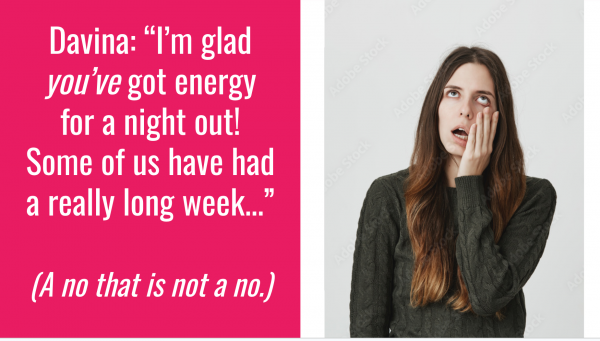
That’s a no – but not really. So often we say no sideways: sarcastically, passive-aggressively, dressing it up to draw attention to needs we haven’t actually expressed.
William Ury’s positive no
The mediator and conflict resolution specialist William Ury wrote a wonderful book called The Power of a Positive No, with a simple formula: Yes! – No – Yes?
- Yes! – say yes to the bid for connection. Affirming, respectful, purpose-driven.
- No – deliver your no clearly and firmly. Non-judgemental, non-emotional, but said.
- Yes? – offer your own proposal. Something that respects the bid for connection but suits you better. Collaborative, future-focused, realistic.
Davina might have said:
“Wow, the film’s out already – I’d love to see it together. (Yes.) I’m actually super tired and ready to get into my PJs, so I’d rather not go tonight. (No.) How about a quiet night in, and we go and see it on Saturday? (Yes?)”
If I were David, I’d feel cherished. The connection is intact. The invitation hasn’t been knocked back. And I’d probably be just as happy to go on Saturday.
The nanny example
I do a lot of work with nannies, where there’s often a big power imbalance – particularly for live-in nannies whose employer is also, in effect, their landlord. It’s a difficult environment in which to be assertive, and a really crucial one.
Imagine the parent calls in the afternoon: “Work’s running late. Could you stay on a bit today?” The nanny had plans she doesn’t need to share – a friend, a date, anything – and she was anticipating leaving at six.
A positive no might sound like:
- Yes!: “I’d have loved to be able to help today.”
- No: “Unfortunately, I’ve got a commitment tonight, and I need to leave by 6pm.”
- Yes?: “With a few days’ notice I can usually be more flexible – and shall I ask my nanny network if someone can step in from 5.30, so I can settle them in with the children?”
It takes practice. Try the positive no in safe spaces first, until it feels natural enough to use when you’re put on the spot.
Step 3: Define your mutual yes
Now ask: how can we make sure our agreement actually works in real life?
When I’m mediating, I help people express their yes, assert their no, and arrive at agreements. Over the years I’ve come to believe that mutually agreed decisions are the single most powerful tool for conflict prevention. Most conflict arises because we’ve avoided a decision, fudged one, or had one imposed on us.
Here are four sub-steps for really good decision-making – what I’d call a proper action plan.
A. Bottom out the trivial details
A mediator’s job is to keep asking: who will do that? How? What will it look like? Where? When? If you don’t have a mediator in the room, give yourself permission to drill into those details. It feels trivial. It isn’t. Doing this builds trust and ensures genuine consensus.
B. Run “what if” scenarios
Reality-check and future-proof what’s been agreed. Pre-agree your plan Bs. This takes the sting out of breakdowns later. When I say to people who’ve just made an agreement, “What will happen if it doesn’t work?” they often say, “Oh, I’m sure it’ll work.” But if I ask, “What happens if Joe can’t do this step in time?” we acknowledge the possibility together rather than reading it as betrayal later. Stress-testing is a mutual responsibility.
C. Agree a review date
If either party is unsure, treat the agreement as a pilot. “Let’s try it for four weeks and review.” That removes the all-or-nothing pressure. Sometimes we need to try something to find out whether it’s right. People are far more likely to buy in to a trial than to a forever-fix.
D. Write it down
Once you’ve reached a verbal agreement, write it down and share it. If your meeting was recorded, run the transcript through AI and ask it to synthesise what was shared, what was agreed, and what actions were set. Don’t just use it as evidence – let it do the work of clarifying. If something hasn’t been properly clarified, go back and clarify it.
A simple email might look like:
“Thank you so much for our conversation today. Just to recap what I understood we decided together: [list]. Was that your understanding too? Looking forward to our review on [date].”
That phrasing matters. I’m not declaring what’s happening; I’m checking we both feel the same way about what we landed on. Memories can be very forgetful – particularly when emotions are high – and it’s not a criticism, it’s just human nature.
Why this matters beyond the workplace
A key tenet of mediation is that things only go on the action plan if everyone in the room agrees to them. Otherwise, for me, it doesn’t go on the list.
We see in modern politics what happens when negotiation breaks down – unilateral decision-making imposed, people strong-armed or threatened. There’s a certain diplomacy we can all really develop, and that we can foster in younger generations too. For me, this is the way towards a peaceable, collaborative community, in personal and professional life alike.
In summary
To lock in win-win decisions:
- Express your yes – including its gradients.
- Assert your no – calmly, with the yes–no–yes? script.
- Define your mutual yes – together, clearly, transparently, and with the detail to stand the test of time.
Thank you so much for reading. Do follow along for future events, and consider joining the Peaceable Community – a live hive mind for people facing, managing or mediating conflict peaceably. Very good luck as you lock in win-win decisions yourself.