Ask for What You Want
How to make clear, respectful requests in difficult conversations
In this Peaceable session, I explore why so many of us find it hard to ask clearly for what we want, especially when emotions, tension, or fear of conflict are involved. You can either watch the webinar or read my article below. Here are my session slides as illustrations for those who prefer to read.
One of the most important things I help people to develop, as a mediator, is the skill of asking for what they want.
That sounds simple, but for many of us it really is not.
Very often, we find ourselves in conflict not because we are difficult people, but because we have been avoiding saying clearly what we want, need, wish for, or would prefer. Instead, we may stay silent, hope the other person will somehow know, hint at the issue, or describe the problem so thoroughly that we imagine they will come up with the solution for us.
In reality, that often leaves both people frustrated.
This article is about how to ask for what you want in a way that is clear, respectful and more likely to go well. It is based on my Peaceable session on this topic, and forms part of my wider series on the five pillars of collaborative dialogue.
Why it can feel so hard to ask for what you want
Many of us were never really given a toolkit for this.
We may have learned, consciously or unconsciously, that speaking up is risky. We may worry that we are asking too much, being unreasonable, creating conflict, or making the other person uncomfortable. Sometimes we hope that if someone really loves us, values us, or understands us, they will simply know what we need without us having to say it.
And when that does not happen, we can feel hurt, disappointed, or even resentful.
At other times, instead of staying silent, we go in the opposite direction. We tell, explain and describe at length. I jokingly call this the TED talk approach: telling, explaining and describing. Those things can all have their place, but if the other person has not been prepared for the conversation, or has not asked for all that information, they can simply feel overwhelmed, blamed or flooded.
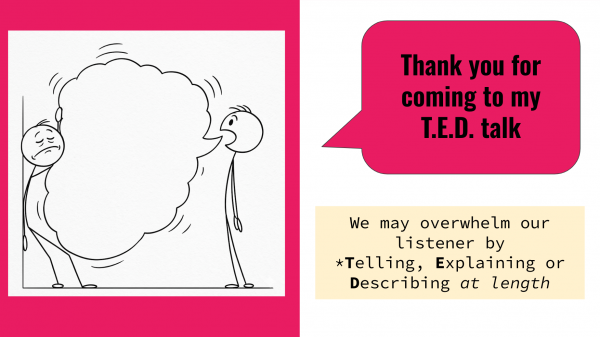
Ask for what you want – don’t give a TED talk
Sometimes we also imagine that if we describe the problem hard enough, often enough, or loudly enough, the other person will both identify the solution and feel motivated to put it into action.
Usually, that is not what happens.
More often, the other person feels confused, criticised, defensive, or threatened.
So the task is not simply to speak. The task is to speak in a way that helps the conversation go well.
Start by knowing what you are asking for
Before we ask for what we want, we need to know what it is.
That may sound obvious, but it matters. If we are still in a problem-focused mindset, then what comes out of our mouth is likely to be a complaint, a criticism, or a description of what is wrong. Helpful though that may sometimes feel, it is not yet a request.
A request points towards the future.
So before you begin the conversation, it helps to ask yourself:
What solution am I requesting of this person for the future?
That shift is important. It takes us from rehearsing the problem to identifying what would actually help.
Step 1: Open the conversation in a way that builds trust
The way we begin matters enormously.
This is not about manipulating anyone. It is about helping both people feel safe enough for a real conversation to happen. Words do part of the work in communication, but one of the most important things words can do is help nervous systems settle.
Some openings tend to trigger resistance straight away. Phrases such as:
- “I’m sorry, but…”
- “I understand, but…”
- “It’s unacceptable…”
- “Unfortunately…”
- “It’s our policy…”
- “This is how we do things here…”
often create a kind of internal “no” in the listener. They can sound dismissive, institutional, blaming or closed down.
By contrast, openings that acknowledge impact, invite perspective, or create collaboration are much more likely to help the other person stay with you.
For example:
- “Can you help me understand?”
- “That sounds upsetting.”
- “How are you feeling about this?”
- “I know that conversation was difficult — how was it for you?”
- “I’m wondering how we can approach this.”
These kinds of phrases help the other person feel that they are being engaged with, not managed.
The importance of a gentle start-up
There is powerful relationship research showing that the tone at the beginning of a conversation often shapes what follows.
If we begin with criticism, contempt, defensiveness or shutdown, the conversation usually deteriorates from there. If we begin gently, with care and clarity, we are far more likely to create something workable.
A gentle start-up might include acknowledging what has been hard, taking responsibility for your own part where appropriate, asking open questions, and showing that you are interested in the other person’s experience as well as your own.
Curiosity helps.
For example, there is often a big difference between asking:
“Why did you say that?”
and asking:
“I’m wondering what made you feel that.”
The second tends to land more softly. It sounds curious rather than accusatory.
Never underestimate the power of appreciation
One of the most powerful ways to settle tension is appreciation.
In many mediation meetings, if the participants are willing, I invite them early on to say something they appreciate about one another. It does not have to be dramatic. It may be a quality, a gesture, a contribution, or something small but meaningful.
Why does this matter?
Because appreciation helps the other person feel less threatened. It reminds them that, despite the difficulty, they are still seen. It helps restore a sense of humanity and safety.
If we can sincerely communicate something we value in the other person, we make it easier for them to hear what comes next.
Step 2: Make the request clearly
This is the heart of it.
At some point, we have to actually ‘say the thing’.
Not hint it. Not imply it. Not circle around it. Not state the negative and hope the other person turns it into a positive. We need to name the request.
One simple format I often share is:
My worry is…
My hope is…
For example:
“My worry is that we’re going to arrive late. My hope is that we might be ready to leave half an hour earlier. Would that be okay?”
This works well because it stays grounded in your own perspective. It is not a demand. It is not an attack. It lets the other person know what matters to you and what you are hoping for.
Helpful phrases that soften without weakening
There are some very useful “I” phrases which allow us to speak honestly and gently at the same time.
For example:
- I wish…
- I worry…
- I wonder…
These can be especially helpful in difficult or high-stakes conversations.
They allow us to name reality without becoming harsh. They communicate sincerity and vulnerability without collapsing into vagueness.
For example:
- “I wish things were different.”
- “I worry that if this continues, it will become harder for both of us.”
- “I wonder whether we could explore another option.”
These are soft starts, but they are not weak. In fact, they often make difficult truths more hearable.
The most useful phrase of all: “Would you be willing to…?”
If there is one phrase I would especially encourage people to practise, it is this:
Would you be willing to…?
It is a remarkably effective way to make a request.
Why? Because it is open. It is respectful. It recognises the other person’s agency. It does not force, trap or corner them. It gives them room to respond honestly, including saying no.
That matters.
A real request is not a disguised demand. The other person must be free to decline. Otherwise, we are not actually inviting dialogue.
So instead of saying:
- “You need to…”
- “Can’t you just…”
- “Why don’t you ever…”
we might say:
- “Would you be willing to let me know earlier next time?”
- “Would you be willing to take the lead on this one?”
- “Would you be willing to tell me if your plans have changed?”
Learn more on the research behind this phrase by Professor Elizabeth Stokoe: https://www.theguardian.com/science/2017/dec/04/would-you-be-willing-words-turn-conversation-around
Using Non-Violent Communication to put it all together
A helpful wider framework for this comes from Marshall Rosenberg’s Nonviolent Communication.
This approach helps us communicate from a deeper place than the reactive surface of conflict. In conflict, we often only speak from the tip of the iceberg: the anger, irritation, accusation or frustration that is visible. Underneath that are feelings, needs, fears, values, hopes, memories and vulnerabilities.
Nonviolent Communication gives us a structure for speaking from more of the iceberg.
The four parts are:
- Observation
- Feeling
- Need
- Request
Let’s look at each one.
1. Observation: say what you noticed
The first step is to describe what you have actually observed, as neutrally and specifically as possible.
This means naming facts, not launching into sweeping judgments.
So instead of saying:
“You never take the bins out.”
you might say:
“I noticed the recycling didn’t go out yesterday.”
That is much easier to hear.
2. Feeling: say how you feel
Next, say how you feel about it.
Not what the other person is. Not what they have done wrong. Not your case against them. Your feeling.
For example:
“I felt worried and frustrated.”
That is useful information. It is not an accusation. It tells the listener something real about your experience.
3. Need: say what matters to you
Then name the need, value or preference underneath the feeling.
For example:
“It’s important to me to feel that we’re being responsible and reliable.”
or:
“I need a bit more certainty to be able to plan my own work.”
This part is crucial. It helps the other person understand why the issue matters. Very often, what softens a conversation is not that we minimise the problem, but that we reveal the deeper value underneath it.
4. Request: ask for something specific
Finally, make the request.
This is where you ask for a concrete future action.
For example:
“Would you be willing to put the bins out next time, or let me know the night before if you can’t?”
That is clear. It gives the other person something specific to respond to. It is future-focused. And it opens the door to a practical arrangement.
A household example
Imagine you are living in shared accommodation, and the recycling has not gone out.
You could say:
“You forgot the bins again. Couldn’t you be more organised?”
But that is likely to trigger defensiveness.
Using this approach, you might instead say:
“I noticed the recycling bins didn’t go out yesterday. I felt worried and a bit frustrated, because it’s important to me that the landlord sees us as responsible and that we are courteous neighbours. Would you be willing to put them out next time, or let me know the night before if you can’t? If needed, I’m happy to do it.”
That is much more likely to lead somewhere useful.
Notice that it is not passive. It is not people-pleasing. It is clear. But it is also respectful.
A workplace example: shared workload
In a workplace, instead of saying:
“You never help with the workload.”
you might say:
“I’ve noticed I’ve taken on the last three client presentations on my own. I’m feeling quite overwhelmed, because I need more support and collaboration. Would you be willing to lead the next one?”
Again, this is specific and workable.
Another workplace example: missed deadlines
Instead of:
“You’re always late with your reports and it ruins my schedule.”
you might say:
“I noticed the report wasn’t submitted by 2pm yesterday as we’d agreed. I felt anxious, because I need reliability in order to complete my own work. Would you be willing to let me know on the morning of a deadline if it’s going to be late?”
That kind of request helps create better arrangements for the future, rather than just replaying disappointment from the past.
If they say no
A request is the beginning of a conversation, not the end of one.
If the other person says no, that does not mean you have failed. It means you now have useful information.
You can then think about your strategy. Your needs still matter. Your values still matter. But now you know that this particular person is not currently agreeing to help in the way you asked.
That gives you a chance to think more clearly about boundaries, alternatives, next steps, or negotiation.
It is far better to have that reality in the open than to stay stuck in resentment, silence, or repeated accusation.
Step 3: Leave silence after the request
This is one of the hardest parts.
Once we have made the request, many of us immediately want to fill the silence. We explain more. We justify. We soften. We apologise. We start talking again because the pause feels uncomfortable.
But that silence is important.
The other person needs a moment to process what you have said.
If we rush to fill the gap, we interrupt their thinking and often water down our own request.
So once you have made your request, stop.
Be quiet! :)
Breathe…
Count to ten internally if you need to!
Let the other person find their response.
Asking for what you want is a skill
This really does take practice. At first it may feel awkward, too direct, or unlike the way you usually speak. But in my experience, when people start practising clear, respectful requests, they often discover that this approach is both kinder and more effective than hinting, blaming, over-explaining or staying silent.
Asking for what you want is not selfish. It is part of healthy dialogue. It is part of good relationships.
And it is often the beginning of better negotiation, clearer agreement, and less resentment.
A recap
If you want a practical way to remember this, here it is:
1. Know what you are asking for
Move from problem-focus to future-focus.
2. Open the conversation well
Use language that helps the other person feel safe enough to listen.
3. Make a clear request
Try: “Would you be willing to…?”
4. Use the wider NVC structure when needed
Observation, feeling, need, request.
5. Leave silence
Say the request, then let it land.
Good luck asking for what you want – and do let me know how you get on!