
Owning your conflict style

Owning your conflict style
Small, realistic shifts for better conversations, repair and human connection
When I ran a recent Peaceable live session called Own your conflict style [watch here], I invited people to do something very simple – and brave.
To gently bring to mind a real disagreement.
A current situation, or something from the past.
And to look at it with curiosity rather than judgement.
Because this work isn’t really about fixing other people.
It’s about understanding how we show up.
I’m Arabella Tresilian, an accredited mediator and founder of Peaceable.
I’ve worked in conflict resolution for nearly ten years now, and one thing I know for sure is this:
Conflict itself is not the problem.
How we respond to it is what shapes whether relationships rupture… or repair.
Beyond right and wrong
I opened the session with a line from the poet Rumi that I return to again and again:
“Beyond ideas of right and wrong, there is a field. I’ll meet you there.”
So much of conflict keeps us stuck in polarity.
I’m right. You’re wrong.
My needs matter more than yours.
But I really do believe there is a space beyond that – and understanding our own conflict style can help us reach it.
A gentle lens: personality and difference
I work a lot with sensitive people – and I include myself in that.
People who care deeply about relationships.
People for whom disconnection, estrangement and unresolved tension can affect mental health in a very real way.
Sometimes it can feel as though we are surrounded by people who are simply… impossible.
There’s a well-known book called Surrounded by Idiots by Thomas Erikson.
It’s a playful title, but it points to something important:
we really are different.
Many workplace models (including DISC and similar colour-based tools) help us notice that some people are more:
- action-focused
- people-focused
- reflective
- task-focused
Our upbringing, work, relationships and life experiences shape how those tendencies develop.
We are not fixed types.
These frameworks are not boxes to trap ourselves in.
They are simply lenses – ways of acknowledging that difference is part of life’s rich tapestry.
Conflict isn’t rare. It’s human.
Often people say to me:
“I don’t really do conflict.”
And I gently smile.
Because conflict isn’t only rows and shouting.
It’s:
- the tension when you want to say no but don’t
- the unease when something feels unfair
- the quiet resentment that never quite gets spoken
Conflict is how we test ideas.
How we negotiate.
How we try to decide what matters.
It only becomes painful when it escalates – or when it stays hidden.
How conflict escalates (and why early matters)

One very helpful way of understanding this is the conflict escalation model developed by Friedrich Glasl.
At the early stages, people may experience:
- tension
- disagreement
- internal debate
- quiet avoidance
In these early “green” stages, there is still genuine potential for win–win.
But when conflict escalates into:
- taking sides
- attacks on reputation
- fear of losing face
- threats
we begin to move into win–lose territory – and relationships start to suffer.
If things continue unchecked, conflict can eventually become lose–lose – where people are willing to damage themselves simply to damage the other.
This is one of the reasons I care so much about helping people notice what is happening early.
Understanding our conflict style helps us “nip things in the bud”.
Two quiet drivers underneath every conflict response
The model I focused on in the session was the Thomas-Kilmann Conflict Mode Instrument (often shortened to TKI).
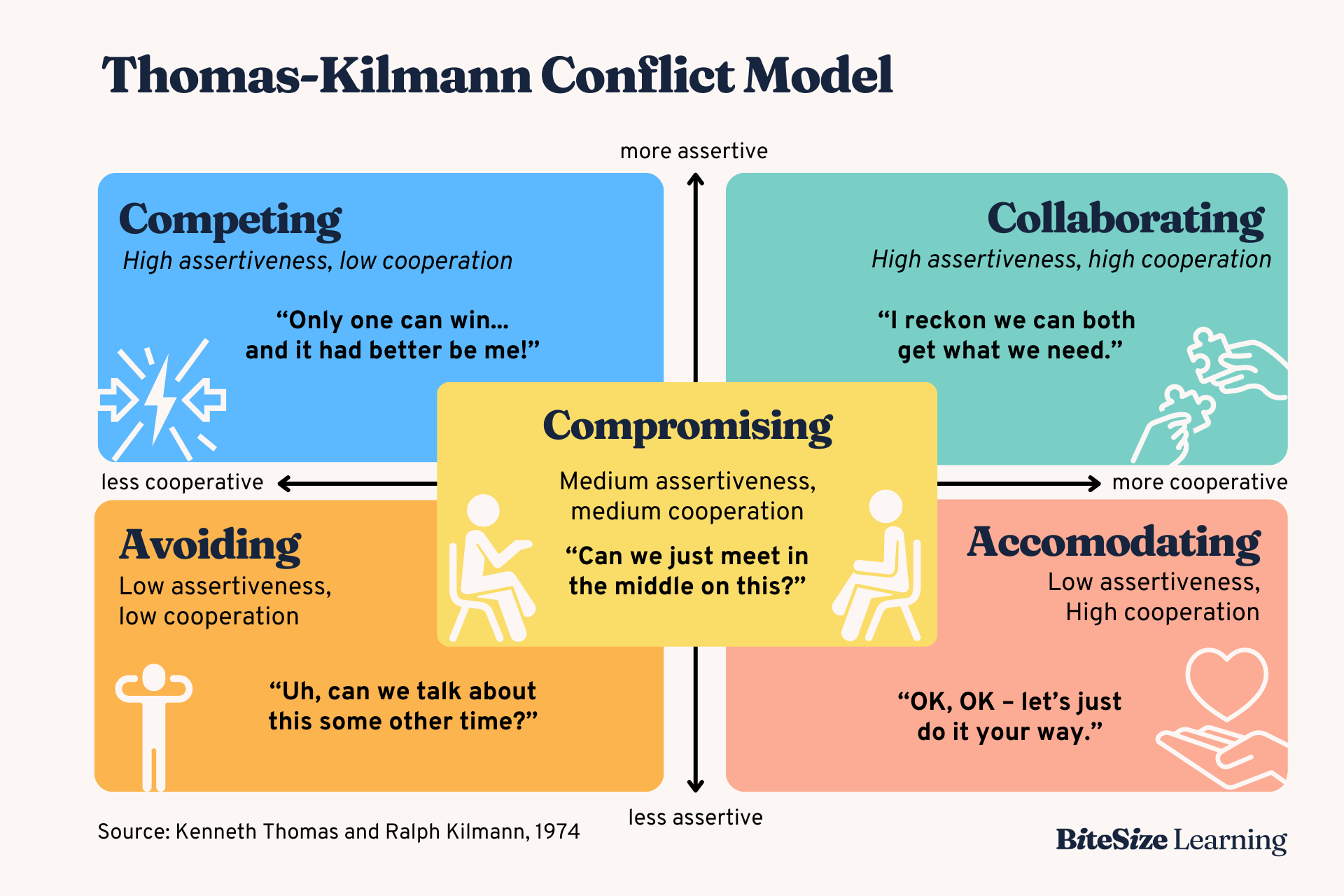
Thomas-Kilmann Conflict Model
It is built on two simple axes:
Assertiveness – how strongly I stand up for the issue, principle or outcome.
Cooperativeness – how strongly I prioritise the relationship.
Another way of saying this is:
- How much does the issue matter to me?
- How much does the relationship matter to me?
Both can come from good intent.
Standing up for principle is not wrong.
Protecting relationships is not weak.
But – and this matters deeply in mediation –
intent and impact are not the same thing.
When we are unaware of how our priorities show up, we can unintentionally escalate conflict.
The five conflict styles (with a light touch of animals)
In mediation we often use simple images and animals to make the styles easier to remember.
1. Avoiding – low assertiveness, low cooperation
The ostrich or the tortoise
“Least said, soonest mended.”
“Let’s not make a fuss.”
“I’ll just leave it.”
Avoiding doesn’t mean you don’t care.
It usually means you care so much that conflict feels unsafe.
But avoiding means the issue isn’t addressed – and the relationship isn’t truly protected either.
2. Accommodating – high cooperation, low assertiveness
The chameleon or the teddy bear
“Oh, that’s fine.”
“Whatever you think.”
“It doesn’t matter.”
This style often comes from a genuine wish to preserve harmony.
Sometimes it also comes from fear of what might happen if we speak up.
Over time, people who accommodate a lot can lose touch with their own needs.
3. Competing – high assertiveness, low cooperation
The racehorse
“It’s my way or the highway.”
“This is about principle.”
Competing can feel courageous and clear.
But when relationships are left behind in the rush to get to the finish line, damage is often done.
Many people who lean towards this style simply need better tools for negotiation – so that strong advocacy does not come at the cost of connection.
4. Compromising – middle ground
The fox or the zebra
“I’ll make you a deal.”
Compromise is useful.
As a mediator, negotiation is at the heart of what I do.
But compromise often means both people leave slightly unsatisfied.
It can quietly become a small lose–lose.
5. Collaborating – high assertiveness, high cooperation
The wise owl or the dolphin
“Two heads are better than one.”
This is where people care deeply about the relationship and about the issues.
They stay with the complexity.
In mediation, this is the moment I love most.
People arrive saying:
- “I won’t give way.”
- “I can’t speak up.”
- “I’m not here to make friends.”
But when they begin to understand each other’s needs – both relational and practical – empathy grows.
Common interests appear.
Creative solutions emerge.
It really does become a 1 + 1 = 3 moment.
We rarely use only one style
Most of us are a mix.
For a long time, I lived mainly in avoiding and accommodating.
I didn’t feel safe enough to advocate for what mattered to me.
I worried that speaking up would rupture relationships.
Then, when things finally became too much, I would swing suddenly into competing.
These loops are very common.
The work is not about becoming perfect.
It is about becoming aware.
There are no right or wrong conflict styles
This is one of the most important messages I share:
There are no good or bad conflict styles.
Only more – or less – effective ways of responding in a particular moment.
Once you start to recognise your own pattern, you can begin to make very small, gentle shifts.
A little more assertiveness.
A little more curiosity about the other person.
A little more willingness to stay in the conversation.
Owning your conflict style: a reflection for you
If you are willing, take a moment and ask yourself:
- When conflict appears in my life, which style do I tend to slip into first?
- What might help me become slightly more able to stand up for what matters?
- What might help me become slightly more open to listening and understanding?
And perhaps – just as gently – ask yourself:
What conflict style might the other person be bringing?
Not to excuse hurtful behaviour.
But to increase understanding.
Owning your conflict style is not about labelling yourself.
It is about giving yourself more choice.
More freedom.
And more possibility for repair, understanding and human connection.
Watch the session recording here:
Own Your Conflict Style session